Yoshio NomuraUndergraduate AI student, UTSBackend and AI inferenceCo-founder, Pyrium
A cheap decision, deciding whether the expensive one runs.
Two of my projects are the same idea twice. In Pulsemind, an XGBoost classifier decides when an ICU event deserves an LLM call. In Develarper, a local Qwen model decides when a task deserves the cloud.
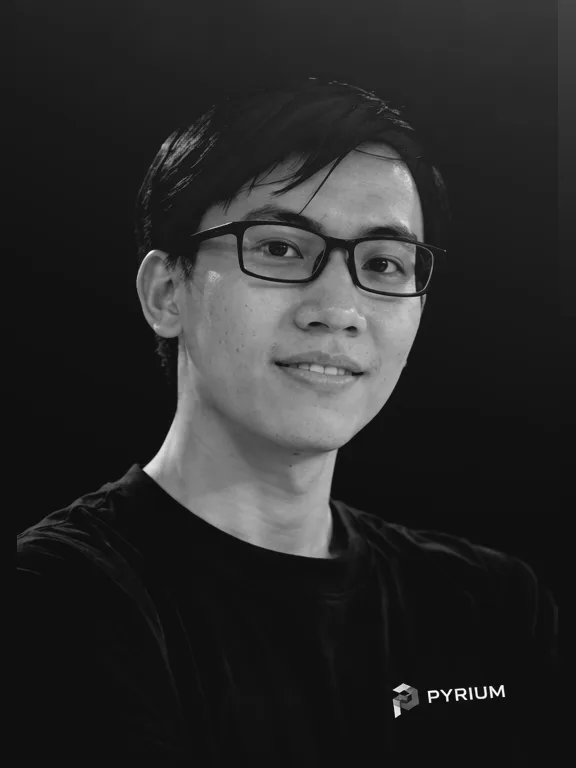
Hi, I’m Yoshio. I build the cheap decision first.
I study Artificial Intelligence at UTS and work from Ho Chi Minh City, on backends and inference: routing, retrieval, and the small model that decides whether a big one is needed. Most of my projects are team work, and every page says which part was mine.
- Studying
- Bachelor of Artificial Intelligence, UTS
- Level
- Undergraduate / intern
- Co-founder
- Pyrium, in development
- Experience
- FlyRank AI, backend AI internship · Jul–Sep 2026, completed
- Based
- Ho Chi Minh City, Vietnam
- ICU stream event
- XGBoost classifier~43 ms score per reading
- only on a detected anomaly
- LLM rationalisation
- Task
- Qwen 2.5 3B router711 of 800 correct tier routing
- only if the task is hard
- Cloud APIotherwise it stays on the local model
Transcript
- Two of my projects are the same idea, twice.
- In Pulsemind, an XGBoost classifier scores every reading from an ICU stream.
- In the demo, scoring a reading and explaining it takes about forty-three milliseconds.~43 ms — including its TreeSHAP explanation — demo service, 7 readings, 31.6–64.7 ms
- Only when it flags an anomaly does the system pay for a language model.
- In Develarper, a small local model reads each task's difficulty first.
- On the team's routing evaluation, it sent seven hundred and eleven of eight hundred tasks to the right tier.711 of 800 — tasks (88.9%), team-labelled routing evaluation, 10 Jul 2026
- Hard tasks go to the cloud. The rest stay on the local model.
- The expensive step runs only when the cheap one asks for it.
Measured
Each result travels with the conditions it was measured under. Sources are listed at the foot of the page.
PulsemindTeam
- Score per reading
- ~43 ms
- including its TreeSHAP explanation — demo service, 7 readings, 31.6–64.7 ms
DevelarperTeam of 4
- Correct tier routing
- 711 of 800
- tasks (88.9%), team-labelled routing evaluation, 10 Jul 2026
- Answer accuracy
- 186 of 200
- 100 factual and 100 summarisation tasks, scored by similarity and Jaccard overlap — not human review, not an LLM judge; 505.1 ms mean, run sequentially
The LanternTeam of 3
- Correct orders
- 10 of 10
- team result — six-turn ordering scenario, direct runs, qwen3:4b on an RTX 3060
- Full voice sessions with the correct basket
- 5 of 5
- team result — synthetic 16 kHz speech streamed in real time, five sessions on one machine
- Model time after the final transcript, median
- 1,341 ms
- team result — the same five sessions
- Time to first audio
- 42.9 s → 5.8 s
- average over a six-turn conversation with real AssemblyAI, Gemini and Cartesia — the first version, since replaced; Yoshio's rate-limiter fix
IgnisTeam of 3
- Final valid explanation, prompt v3
- 21 of 24
- against 14 of 24 for v2 — 12 synthetic scenarios, two runs each, DeepSeek-V4-Flash on the event's AMD API; preliminary
- Model time, median, prompt v3
- 10.3 s
- against 21.3 s for v2 — the same runs, concurrency 1
- OCR mean character error, text and tables
- 0.000
- MinerU, four synthetic document families and a held-out table image
- OCR mean character error, diagrams
- 0.617
- MinerU, the held-out synthetic diagram family
RoomieContributor, team of 4
- Users onboarded
- ~50
- real users who onboarded and swiped at demo day
- Average request latency
- ~12 ms
- structured matching path only — excludes embedding generation
Hackathons I’ve built at
- NVIDIA · OpenACC
- Viettel
- AssemblyAI
- lablab.ai
- OpenAI · Devpost
- AMD
- GDGoC
Working demos.
Only projects with a demo that runs today. Ignis and The Lantern run on free servers that take about a minute to wake on a first visit.
- The LanternSeptember 2026
The Lantern
AssemblyAI Voice Agent Hackathon · lablab.ai
A voice maître d' that checks every order change against the live menu before the kitchen sees it.
- ArchitectureLabSeptember 2026
ArchitectureLab
OpenAI hackathon · Devpost
A person and an agent share one live system model; the agent acts only through WebMCP tools.
- Weatherise9–11 June 2026
Weatherise
Vietnam AI Open Hackathon (NVIDIA / OpenACC)
REST sources and Earth-2 surrogates feed a Nemotron Ultra agent chain with Qdrant retrieval.
- IgnisOctober 2026
Ignis
AMD Developer Hackathon, Act III · lablab.ai
Work orders reviewed by a person, then issued as evidence-linked reports.
11 projects, grouped by what they do.
Team or solo on every row. The red dot marks work built with the Pyrium team.
| Project | What it does | Attribution | When | Measured |
|---|---|---|---|---|
| Gated inferenceA cheap decision in front of an expensive model call. | ||||
| Pulsemind | ICU telemetry: an XGBoost classifier gates LLM rationalisation to detected anomalies. | Team — full-stack AI engineer | May 2026 — ongoing | 1 result |
| Develarper | A local Qwen 2.5 3B classifier routes hard tasks to a cloud API; easy ones stay local. | Team of 4 — LLMOps | July 2026 | 2 results |
| Retrieval and agentsGetting the right context to a model; agents acting through tools. | ||||
| The Lantern | A voice maître d' that checks every order change against the live menu before the kitchen sees it. | Built with the Pyrium team. Team of 3 — dialogue logic and reliability | September 2026 | 4 results |
| ArchitectureLab | A person and an agent share one live system model; the agent acts only through WebMCP tools. | Built with the Pyrium team. Team of 3 — scaffold, WebMCP adapter and deployment | September 2026 | Nothing measured |
| Weatherise | REST sources and Earth-2 surrogates feed a Nemotron Ultra agent chain with Qdrant retrieval. | Built with the Pyrium team. Team — LLMOps & Backend AI Engineering | 9–11 June 2026 | Nothing measured |
| Local RAG API | Ask questions of a PDF; each answer returns its sources and inference time. | Solo | February 2026 | Nothing measured |
| Services and dataAPIs, pipelines and what runs under them. | ||||
| Ignis | Work orders reviewed by a person, then issued as evidence-linked reports. | Built with the Pyrium team. Team of 3 — backend AI engineering, benchmarking and system verification | October 2026 | 4 results |
| AgentRisk DaaS | A risk-data API for the MCP, npm and PyPI packages agents depend on. | Solo | March – August 2026 | Nothing measured |
| llmops | A self-hosted inference node with rate limiting, a reverse proxy and metrics. | Solo | March 2026 | Nothing measured |
| Roomie | Roommate matching by cosine similarity over survey vectors, with WebSocket chat. | Contributor, team of 4 — DevOps & Backend Engineering | April 2026 | 2 results |
| Vora | A backend resolver turns model output into validated, dependency-mapped graphs. | Team — backend engineer | April 2026 | Nothing measured |

Co-founder, Pyrium.
A three-person brand building private, cost-aware agentic AI. With Long Quan (Bennedict) Ton and Huynh Khanh Tuong. Since October 2026.
Brand in development, not incorporatedVisit PyriumExperience
FlyRank AI — Backend AI Engineer, Internship (Remote)
Completed both the Backend AI Engineering and AI Fluency tracks; certificates issued 16 September 2026.
Credentials
Titles open the certificate and, where offered, the issuer's verifier.
| Credential | Issuer | Kind | Issued |
|---|---|---|---|
| Backend AI Engineering | FlyRank AI Internship Program | Programme completion | 2026-09-16 |
| AI Fluency | FlyRank AI Internship Program | Programme completion | 2026-09-16 |
| Dean's List 2026 | University of Technology Sydney | Academic honour | 2026-07-09 |
| Certificate of Attendance | Vietnam AI Open Hackathon (NVIDIA / OpenACC) | Certificate of attendance | 2026-06-09 |
| Top 30 Finalist Award | GDGoC National Hackathon 2026 (Hanoi) | Competitive placement | 2026-05-20 |
| Next.js App Router Fundamentals | Vercel | Course completion | 2026-02-20 |
| Generative AI with Large Language Models | DeepLearning.AI & AWS — via Coursera | Course completion | 2026-01-02 |
| AWS Cloud Practitioner Essentials | Amazon Web Services (AWS) | Foundational course completion | 2025-12-03 |